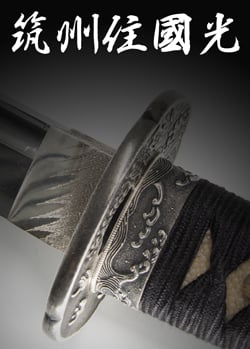
It’s a piece of fine art. A blade forged using skills that have been carried forward, smith to apprentice, through the centuries.
Producing a Shinsakutou calls for distinct traditional crafts to work in harmony: Tamahagane smelted from iron sand in a Tatara, masterfully combined with carbon and then folded to form the unique Japanese blade structure and signature Hada.
The Hamon, crafted laboriously using clay to coat the blade before quenching, producing the mesmerising temper lines and in doing so defining the Sori of the blade.
The blade passes through the hands of the polisher, the Shirogane-shi and the Saya craftsman before the finished sword is ready for final appraisal and registration.
Not Available For Sale Online - Please get in touch to view or purchase.
We source our Shinsakutou from Nosyudo, based in Seki, Gifu — a town with roots as a centre of swordsmithing stretching back some 700 years to the Kamakura period. Company president Keiji Igarashi, continuing the work of his father and the company's founder, Nosyudo works with a network of licensed swordsmiths across Japan, several of them Mukansa-certified — the highest rank a Japanese swordsmith can hold — and many carrying forward names and techniques passed down within their own families across generations.
Each smith works within one or more of the five traditional schools (gokaden) of Japanese sword-making — Bizen-den, Soshu-den, Mino-den, Yamato-den, and Yamashiro-den — each with its own characteristic shape, hamon, and jigane.
The swords linked here detail the smith, lineage, and tradition behind each individual blade.